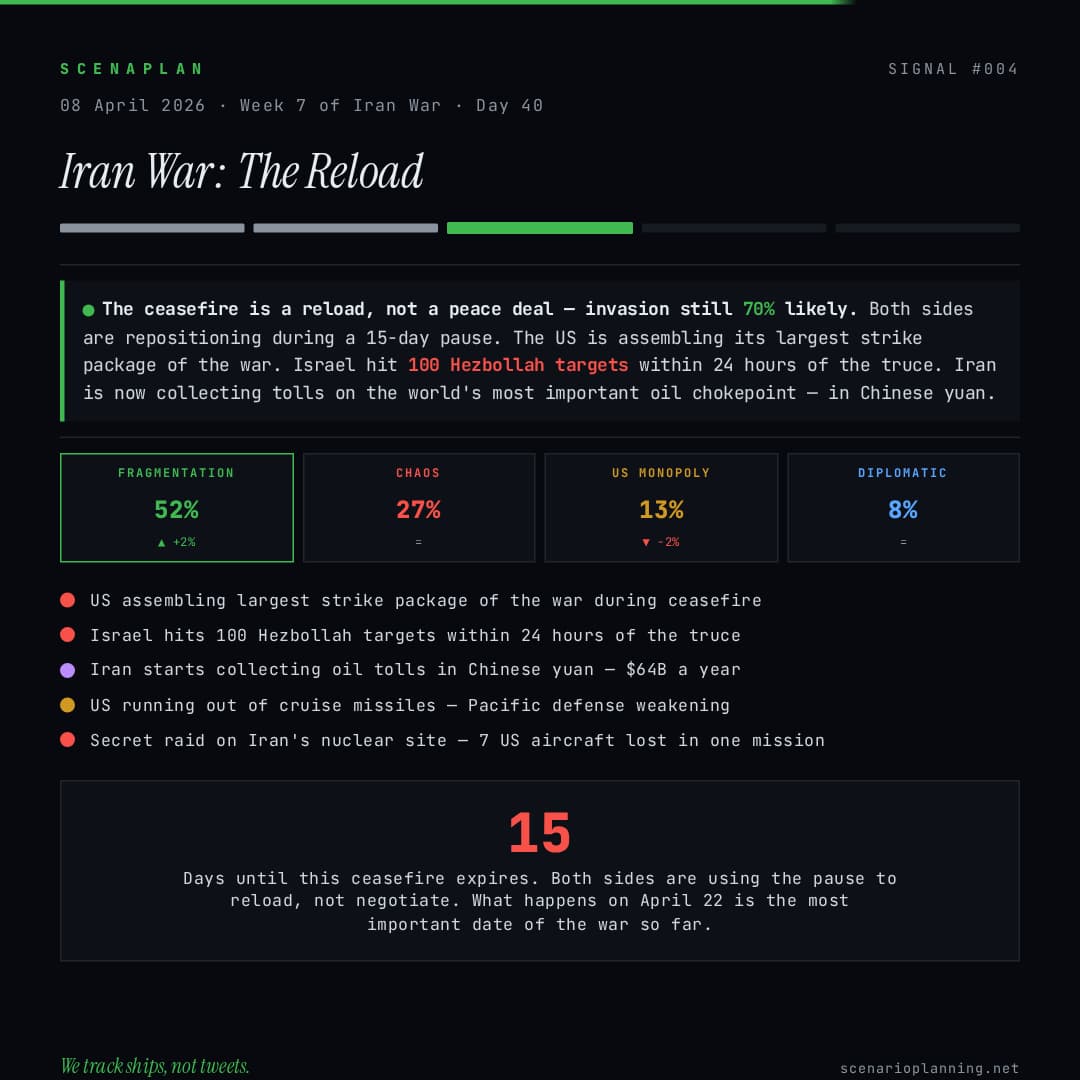
On April 7, the United States and Iran announced a ceasefire.
On April 8, Israel hit a hundred Hezbollah targets in ten minutes, Iran started charging ships to transit the Strait of Hormuz in Chinese yuan, and three US carrier strike groups continued loading the largest bunker-buster strike package assembled since the Gulf War.
This isn’t a peace deal. It is a 15-day tactical reload.
Here is what actually happened during the week everyone exhaled.
The Khamenei Call
The backstory matters more than the announcement.
Axios reconstructed the sequence. For the first time since the war began, Supreme Leader Khamenei personally authorized the ceasefire. Not the foreign ministry. Not a proxy channel. Khamenei himself, through a mediation triad – Pakistan, Egypt, and Turkey – that had been running parallel to the kinetic campaign for ten days.
The problem: the US and Iran are operating on incompatible texts.
The Americans assured Israel that the deal includes Iranian denuclearization and a wind-down of the ballistic program. Iran’s Supreme National Security Council published a statement the same day saying no such demands exist in the agreed framework. Both sides are correct about what they were told. Neither side is correct about what the other agreed to.
The Pentagon’s internal assessment, leaked 72 hours before the announcement, called the situation “madness.”
Iran’s foreign minister put the emotional register on the record: “Our hands remain upon the trigger.”
You do not accept a ceasefire while your intelligence chief’s body is still warm from an Israeli airstrike – unless the 15-day window is worth more to you than retaliation.
Model relevance: The ceasefire is a single-point-of-failure instrument. Reversal governance on the Iranian side runs through Khamenei alone. On the US side, Trump overrode hawks after consultations with Israel and Pakistan. P(10-point plan implemented as stated) < 10%. P(collapse ≤ Day 15) = 0.65. Ground Operation (BIF-1) adjusts to 70%, down 3 from last week – not because the operation is less likely, but because the timeline absorbed one more cycle.
The Isfahan Price
On April 3, an F-15E Strike Eagle was shot down deep inside Iran. Shoulder-fired missile. Both crew survived.
What happened next was the worst single-mission combat search-and-rescue loss in modern American history.
The CSAR package went in. Two MC-130J Commando IIs got stuck in soft sand and had to be destroyed in place. Up to four Black Hawks were lost or damaged in the extraction. Six airframes total – to recover two pilots.
The Pentagon framed it as a success. “Safe and sound,” said Trump. And the pilots are alive, so technically he is not wrong. But the cost curve is the story.
Iranian IADS and MANPADS contested US deep-inland rescue envelopes at levels planners had not priced. Every future CSAR cycle inside Iran now carries this cost. Every deep-strike mission that puts aircrew over Iranian soil requires acceptance of this attrition rate on the rescue side.
This is the number that broke Swift Capture.
The Branch A scenario – quick decapitation, air superiority, regime collapses – requires the ability to operate over Iranian airspace without bleeding airframes on every recovery. Isfahan proved that assumption wrong. Not catastrophically. Not in a single dramatic loss. In the quiet, grinding arithmetic of six airframes for two pilots.
Four days later, Trump offered a ceasefire.
Model relevance: Swift Capture (Branch A) drops to 15%, down 3. The air-superiority precondition is broken. This is also the structural driver behind the emergence of NL-2 MOP Enforcement – a standoff strike using B-2s and Massive Ordnance Penetrators that avoids the CSAR exposure entirely. The model now carries this as a separate branch at 28%, on probation.
The Loading Dock
While the ceasefire was being announced, three carrier strike groups were converging on the Persian Gulf.
The Abraham Lincoln CSG has been on station in the Arabian Sea running nonstop combat operations. The Gerald R. Ford CSG – already on an 11-month deployment, the longest in a generation – departed Split, Croatia on April 2 and is heading for CENTCOM. The George H.W. Bush CSG sortied from Norfolk on March 31.
Here is the detail that matters: the Bush sailed seven days before the ceasefire was announced. No decision to deploy a carrier strike group is made in fewer than ten days. The deployment order predated the peace talks.
None of these deployments were reversed after the ceasefire.
On the ground: the Tripoli ARG with the 31st Marine Expeditionary Unit is on station – roughly 3,500 sailors and Marines with sea-based F-35B strike capability. The Boxer ARG with the 11th MEU was accelerated three weeks out of San Diego and is transiting the Pacific.
Peak force overlap: approximately April 21. One day before the ceasefire expires.
And then there are the B-2s.
Planet Labs satellite imagery from April 1 confirmed six B-2 Spirit stealth bombers at Diego Garcia. Six aircraft is 30% of the operational B-2 fleet. It is also the exact force package sized for the 2025 Fordow strike plan – the contingency for destroying Iran’s dispersed underground enrichment facilities using Massive Ordnance Penetrators.
You do not forward-deploy 30% of your stealth bomber fleet to a remote Indian Ocean atoll during a peace process.
Let’s call this what it is: the ceasefire is a logistics window. The force generation timeline and the diplomatic timeline converge on the same date. April 22 is not a deadline for peace. It is a readiness date.
Model relevance: Ground Operation (BIF-1) holds at 70%. Bloody Landing (Branch B) rises to 57%, up 2 – the dominant conditional pathway. The B-2/MOP concentration creates a new scenario not previously in the tree: a standoff enrichment strike as ceasefire enforcement, no ground landing required. Formalized as No Landing branch NL-2 (MOP Enforcement) at 28% of the 30% No Landing envelope. On probation – requires corroboration of force-generation indicators by Signal-006 or auto-cuts to 15%.
The Lebanon Test
If you wanted a single data point to test whether the ceasefire is real, you got it within 24 hours.
On April 8, the IDF struck approximately 100 Hezbollah targets across Lebanon in roughly ten minutes. It was the largest single Israeli military action of the entire war.
Netanyahu had warned this was coming. On April 4 – three days before the ceasefire announcement – he called Trump and asked him to “hold off.” That call was not a bluff. It was a pre-commitment signal, delivered to the one person who could have stopped it.
Nobody stopped it.
The mediators – Pakistan, France, Egypt – assert that Lebanon is inside the ceasefire envelope. Israel rejects this interpretation. Netanyahu’s position, stated publicly on April 8: “The ceasefire does not cover Lebanon.”
Here is what the hundred-strike barrage tells you about the architecture of the pause. The ceasefire is a posture, not a settlement. It holds on the US-Iran track because both sides need the 15-day window – the US for force generation, Iran for structural wins. It does not hold on the Israel-Hezbollah track because Netanyahu operates on a different optimization function entirely: political survival through perpetual conflict.
Iran tolerated the strike. The SNSC accepted the ceasefire while Lebanon was being hit. This is the single biggest tell of the week. The 15-day reload is operationally worth more to Tehran than retaliation for a hundred targets destroyed on its most important regional proxy.
Model relevance: NL-1 Indefinite Reload (the frozen conflict default) is reinforced as the base case within the No Landing envelope at 40%. P(ceasefire collapse ≤ Day 15) rises to 0.65, with the Lebanon axis as the most likely fracture point.
The Tollbooth
While the military reload runs its course, Iran is building something permanent.
The Strait of Hormuz toll regime went operational in late March. Lloyd’s List confirmed it by March 25. The settlement currency: Chinese yuan and USD-pegged stablecoins. SWIFT and the US dollar are excluded. Flag-based discrimination applies – Chinese and Indian carriers get preferential access. Western-flagged vessels are effectively priced out.
Iran’s 10-point ceasefire proposal codifies this arrangement, with an Oman revenue-sharing clause built in. The $64 billion annual revenue figure was broadcast on Iranian state television on April 8 – the first on-record government projection.
Let’s call this what it is: The Tollbooth Strategy.
Iran is converting a wartime chokepoint blockade into a permanent yuan-denominated rent stream. Any ceasefire that “reopens Hormuz” now cements Iranian administrative control and yuan settlement as the new baseline. The war’s financial endgame is being decided while the military campaign is still loading.
The zero OFAC response in the first seven days is the loudest signal. The US Treasury has not sanctioned the toll mechanism. It has not sanctioned the PBoC settlement infrastructure underwriting it. Inaction is a form of acceptance – or at least an admission that enforcement is not currently possible while the military operation consumes all bandwidth.
China’s official position: “neutral, calls for de-escalation.” China’s observable action: providing payment rails for a US-sanctioned state collecting yuan rent on the world’s most important oil chokepoint.
Model relevance: Fragmentation endgame rises to 52%, up 2. US Monopoly drops to 13%, down 2. The Tollbooth is a Layer 1 observable on the L0 energy architecture – it structurally weakens the US-controlled oil order independent of the battlefield outcome. Even if the US wins the war, the yuan settlement precedent survives.
The Magazine
There is a reason the ceasefire happened when it did, and it is not diplomacy.
In the first four weeks of Operation Epic Fury, the US fired over 850 Tomahawk cruise missiles. 168 in the first hundred hours – roughly three years of peacetime production consumed in four days. Approximately 400 missiles – 10% of the total US inventory – were expended in the first 72 hours alone.
Pre-war inventory: approximately 3,100 Tomahawks. Current procurement rate: 90 per year. The FY2026 budget request: 57 missiles. Raytheon’s planned scale-up to 1,000 per year will not be operational until March 2028. Minimum replenishment timeline: five years.
The Tomahawk magazine is now below Pacific contingency reserve levels.
This is the number that almost nobody is talking about. Every cruise missile fired at Iran is one not available for a Taiwan contingency. The Pacific deterrence posture – the cornerstone of US strategic architecture in Asia – is being depleted in the Gulf.
Trump’s threat to hit “bridges and power plants” is not materially backable at current magazine depth. The ceasefire is not generosity. It is a resupply window disguised as diplomacy.
Model relevance: The Tomahawk crisis is the structural driver behind the BIF-1 gate decline from 73% to 70%. It is also the primary input to NL-4 (US Withdrawal / Pacific Pivot) at 12% within the No Landing envelope. US Monopoly endgame continues to erode – now at 13%, down 2 from last week – driven by Pacific deterrence leakage independent of the Iran battlefield outcome.
Model Position
Ground Operation (BIF-1): 70% ▼-3 The gate absorbed one more delay cycle. Force generation continues through the ceasefire. The timeline and the force posture converge on April 22.
Conditional on operation happening:
- Swift Capture (A): 15% ▼-3 – Isfahan CSAR broke the air-superiority precondition
- Bloody Landing (B): 57% ▲+2 – dominant pathway, force posture + Israeli pre-commitment
- Op Delayed (C): 28% ▲+1 – Khamenei-authorized, 15-day absorption
No Landing (BIF-1b): 30% ▲+3 Five distinct alt-pathways. New structural node this issue.
- Indefinite Reload (NL-1): 40% – default classification, frozen conflict
- MOP Enforcement (NL-2): 28% – PROBATION, auto-cut if uncorroborated by Signal-006
- Negotiated Freeze (NL-3): 15% – requires 6 weeks zero strikes + no ultimatums
- US Withdrawal (NL-4): 12% – Pacific pivot under magazine pressure
- Pre-landing Regime Change (NL-5): 5% – residual
Endgames:
- Fragmentation: 52% ▲+2
- Chaos: 27% =
- US Monopoly: 13% ▼-2
- Diplomatic: 8% =
Portfolio Compass
Scenario analysis, not investment advice.
BTC – Hold. Jurisdictionless thesis intact. Hormuz yuan toll + CIPS volume + Pacific deterrence leakage all reinforce the structural bid. But the Day-15 clock creates binary volatility. Accumulate on confirmed dips, not preemptively.
Gold – Hold. Fragmentation at 52% sustains the central bank buying thesis. No reason to sell. No reason to chase.
Oil – Watch. Brent dropped 16% on the ceasefire. The market priced in clean Hormuz reopening at >80% probability. The model says P(collapse ≤ Day 15) = 0.65. That is an asymmetric setup – but the binary outcome is too sharp to build a position pre-clock.
Cash – Keep 30% dry. Highest-conviction call this issue. April 22 is the highest-convexity date of the quarter. Whether the truce fractures or extends, the volatility spike creates the entry point. Dry powder is the position.
What to Watch
April 22 – The Clock
This is the date. Everything else is preamble.
The 15-day ceasefire expires. Three outcomes fork from this single point. If fighting resumes, the ground operation gate jumps back above 73% and the Bloody Landing pathway executes – three carriers on station, MOP package loaded, Marines forward-deployed. If the truce extends, the Indefinite Reload becomes the base case – a frozen conflict with periodic strikes and no resolution, grinding down both sides until magazine depth or political exhaustion forces a decision. If the B-2s hit dispersed enrichment sites as a ceasefire enforcement action – no ground landing, standoff only – the war takes a path nobody in the press is currently modelling.
Watch for: movement orders. Not statements. Not press conferences. Ships that change course in the 48 hours before April 22 will tell you everything the diplomats won’t.
The Bomber Test
Six B-2s at Diego Garcia is confirmed. That is 30% of the operational fleet and the exact Fordow strike package. The question is whether it stays a deterrent or becomes a firing solution.
Between now and Signal-006, four things either happen or they don’t. MOP munitions transfer via C-5 Galaxy. Public discussion of dispersed enrichment targeting. A third carrier entering the CENTCOM area of operations. B-2 repositioning to a forward operating location.
If two or more of those fire, the standoff strike option is real and the model keeps it at 28%. If fewer than two – the bombers were coercive theatre and the weight auto-cuts to 15%. No debate needed. The indicators decide.
The Yuan Meter
This one moves slowly, but it is the one that matters most after the shooting stops.
Iran is collecting tolls in yuan through the Strait of Hormuz right now. The question is whether it sticks. If April toll revenue is published and the CIPS monthly volume breaks 900 billion, the dollar’s monopoly on Gulf energy settlement is structurally cracked – not by a war, but by a toll booth. If a Gulf state – any Gulf state – formally requests a US force drawdown during the ceasefire window, the coalition architecture fractures and everything downstream shifts.
This is the indicator that outlives the war. Track the currency, not the carriers.
The carriers are converging. The bombers are loading. The yuan is settling.
And the ceasefire clock is ticking down from fifteen.
Track the ships, not the signatures.